


How Emperor Constantine Palaiologos’ Heroism Shaped the Soul of Modern Greece

If the urban legends are to be believed, “The city has fallen and I am still alive” were the last, painful words of Constantine XI Palaiologos, the last Byzantine Emperor.
On May 29 1453, as the world of Byzantium crumbled around him, its last emperor faced an impossible choice between heroism and humiliation. The story of his final hours on the walls of Constantinople is a blur of history, covered in myth and proud stories of national identity. It is a story that still moves modern Greece, showing how interconnected the identities of the Byzantines, the Eastern Romans and the modern Greeks are. While no one doubts that Constantine Palaiologos died like a hero, how exactly he fell remains a mystery that gave rise to one of Greece’s most prominent modern legends.
The facts, as much as we can ever know them, are pieced together from the accounts of men who were there at these historic moments for the entire region. The Venetian surgeon Nicolò Barbaro wrote in his ”Giornale dell’assedio di Costantinopoli” about the pure chaos that engulfed Constantinople as the Turks were advancing towards the once mighty Byzantine capital. Similar accounts we find in Archbishop Leonard of Chios’ writings in his letter he sent to Pope Nicholas V. Their accounts agree that Constantine, facing the vast army of Sultan Mehmed II, refused to flee or surrender his city.
As the final assault began and Ottoman banners appeared on the ancient Theodosian Walls, legend has it that the Emperor tore off his purple imperial regalia in a last gesture of pure heroism. He wanted no distinction from the soldiers he was about to die with, becoming one of them rather than their leader and commander. He then plunged into the chaos near the Gate of St Romanus and was simply lost to sight. Mehmed wanted the body found, and a head was later brought to him, but its identity was never truly certain. That historical detail of doubt as to what actually happened to Constantine Palaiologos was all that was needed for a new story to begin.
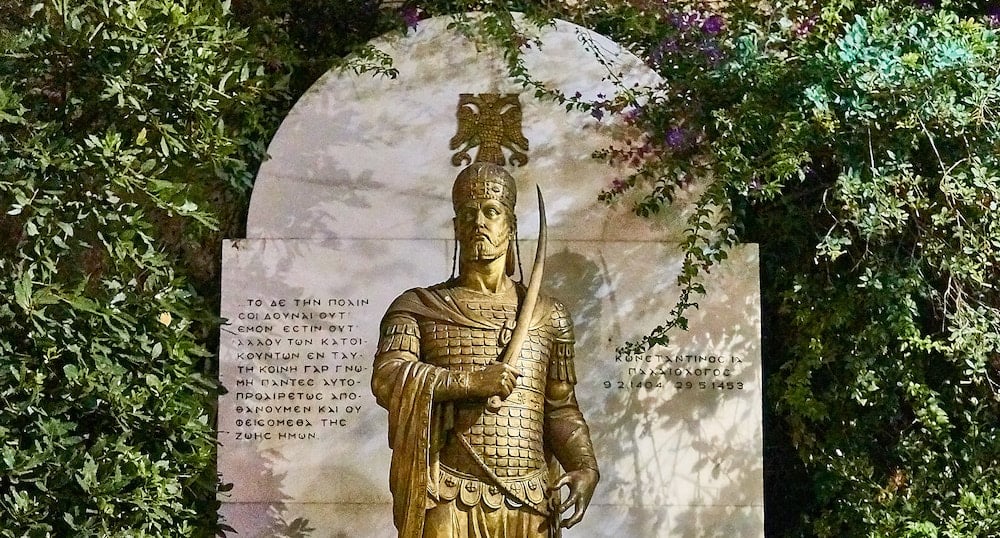
How Constantine Palaiologos became the marble Emperor
In the centuries of Ottoman rule that followed May 29, 1453, a different story began to circulate among the Greeks, who now found themselves under Ottoman occupation. This story insisted that the last Byzantine Emperor Constantine XI Palaiologos never died. In his final moment, an angel swept down, turned him into marble and secreted him away in a cave deep beneath the city’s Golden Gate.
There, the “Marmaromenos Vasilias”—roughly translated as the Petrified Emperor—sleeps and awaits the day of liberation. This legend of the Greeks promises he will one day awaken, reclaim his city and restore the Christian empire that gave way to the advancing muslims. The legend is a well-known one with most modern Greeks knowing it to this day, as it continues to pass down generations, more than 550 years after the fall of Constantinople.
The myth became a revolutionary touchstone that united the revolting Greeks of the early 19th century. Theodoros Kolokotronis, one of the greatest heroes of the 1821 Greek War of Independence, saw his fight as a continuation of Constantine’s. He spoke of his men as the Emperor’s new guard, fighting the same enemy. The sleeping king connected the struggle for a modern Greek nation directly back to the glory of Byzantium, providing a divine promise that victory was inevitable, as God was on the side of the Greeks. The legend also became the spiritual fuel for the “Megali Idea” the dream of a greater Greece with its capital once more in a liberated Constantinople, rather than in Athens.

How the final moments of Constantine Palaiologos still define Greece
Even now, in 2025, Constantine Palaiologos holds a unique place in the Greek national soul and the identity of the nation. His statue in Athens isn’t that of a triumphant king but of a martyr, opposite the humble Orthodox Cathedral of Athens, overlooking the faithful flock. He stands there reminding the Greeks of his holy ”chreos”—the profound sense of duty and debt to one’s homeland, as he became the bridge that connects the modern Greek state with its medieval predecessor.
His story symbolized the heroic failure of the Greeks, who might have lost their multinational Empire, but remained united as a nation and revived when the time was right. The story of Constantine Palaiologos also reminds the nation that their culture often celebrates tragic heroes over victorious kings.
Because his death is shrouded in mystery, Constantine Palaiologos managed to become a symbol. While the rest of the world sees the fall of Constantinople as an important historical event, for many Greeks, it remains an open national wound; therefore, the legend of the Marble Emperor ensures that Constantine Palaiologos didn’t die in vain. He became a hero whose task was to ensure the continuation of the national identity of the people who called themselves Romans but were purely Greek.
Business Wire



No comments