


Asa Jennings: The American Who Rescued 350,000 Greeks from the Smyrna Massacre
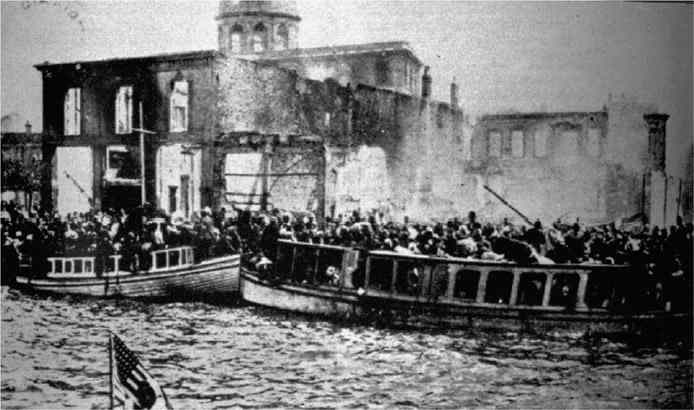
Asa Kent Jennings was the unsung American hero who helped save over 350,000 Greeks from slaughter by the Turks in the port city of Smyrna in 1922.
For thousands of years, Smyrna was the wealthiest of cities located on the Aegean coast of what is now modern Turkey. It was a cosmopolitan city known for religious tolerance, as it was inhabited by Greeks, Armenians, Turks, and Jews among others, all living and working together.
Yet, in 1919, the “Young Turk Revolution” established a nationalist government that started a lethal campaign calling for the destruction and persecution of the Christians of Asia Minor, Pontus, and Eastern Thrace.
At the end of World War I, the Eastern Mediterranean was in chaos. In 1919, Greek armed forces entered Asia Minor to reclaim Greek lands that had been usurped by the Ottomans after the fall of Constantinople. The Greco-Turkish War lasted three years, and, by 1922, the Turkish army had won, forcing the Greek troops to retreat.
The defeated Greek forces withdrew in September 1922, chased away by the Turkish troops who were led by the founder of the new nation, Kemal Ataturk.
Jennings arrives in Smyrna right before the destruction

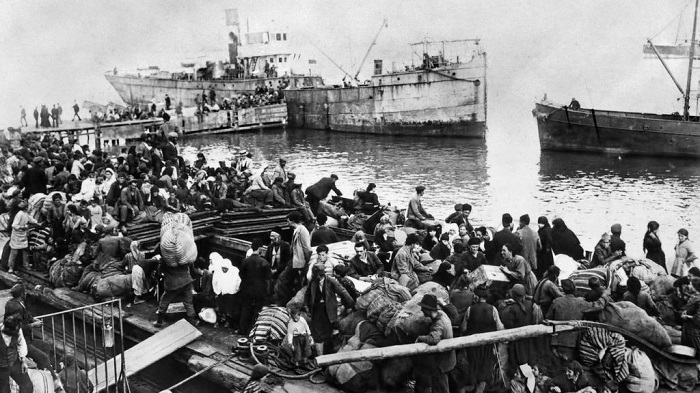
Asa Kent Jennings arrived in Smyrna as head of the YMCA (Young Men’s Christian Association) in 1922 only fourteen days prior to Turkish troops’ entering the city, which was, at the time, largely a Christian one. Upon entrance of the Turkish army, about 350,000 Greeks, Armenians, and Jews were trapped with no way out. The sea was to their west and the approaching Turks to their east.
The Turkish troops were ruthless in entering the Greek, Armenian, and—to a lesser extent—Jewish neighborhoods, with the fire primarily targeting Greek and Armenian quarters. They looted homes and set them ablaze, raping, torturing, and killing residents. Those who attempted to escape by sea drowned when trying to reach the foreign ships anchored nearby. Others chose to jump into the sea to escape from the raging Turks.
American and British warships were stationed off the coast to pick up their own fleeing citizens. As neutral forces, they were not allowed to get involved.
Jennings sent his family to the safety of the American ships but stayed behind to see how he could help the Smyrna Greeks and other Christians who were trapped in the blazing city. He arranged for food supplies to be brought in to feed the refugees. Despite the danger, the American hero was determined to prevent the impending massacre of those unable to flee.
Jennings risked his own life by traveling through the chaos to meet with the Turkish leader, Ataturk. In a way that some would deem miraculous, he managed to convince the much feared Ataturk to allow the non-Muslim refugees—with the exception of men aged 18 to 45—to leave Smyrna but was only given eleven days to find them a safe passage out of the country.
Jennings’ plan to save the Greeks
Jennings immediately contacted the Greek government by cable to request that they provide ships to get the refugees to safety. The Greek officials were puzzled as to who he was. As the only American left in Smyrna, Jennings introduced himself as the top American official in the city and threatened to expose the Greek government to the world.
He essentially blackmailed Prime Minister Nikolaos Triantafyllakos, threatening to internationally denounce the Greek government for criminal inaction and responsibility for the loss of countless lives. Finally, the order was given for the intervention of the Greek navy under the supervision of the American fleet in the region, and 26 ships rushed to provide aid. Jennings directed them into the port, and the Greek ships picked up the refugees within the eleven-day window frame permitted by Ataturk.
Word of Jennings’ deeds reached other ports along the Aegean coast. Radio requests were sent out to fetch refugees. Jennings spent much of the following year directing an expanded fleet of 55 ships to ports from the Black Sea to Syria. By the end of 1923, he and his crews had retrieved over 1.2 million refugees, many of whom would have faced certain death had they remained in Turkey.
The Greek government honored Asa Kent Jennings for his contribution to the rescue of refugees from the burning city, his diplomatic mediation, and the repatriation of prisoners of war from the Asia Minor campaign. The Greek State presented him with the Golden Cross of the Order of the Savior and the Medal of Military Merit.
The American hero was a former Methodist pastor
Asa Kent Jennings was the second of six children, born on September 20, 1877 to Hiram Jennings and Emma Carvy in Webster, New York. He attended several classes at Syracuse University prior to beginning his career at the YMCA in Utica, New York.
He met Amy M. Will while working at the YMCA, and they were married on August 5, 1902. Together, they had four children: Ortha, Asa Will, Wilbur Ferguson, and Bertha Marguerite.
In 1904, Jennings was diagnosed with Pott’s disease, or acute tuberculosis of the spinal cord, a potentially terminal illness. He spent several months in the Adirondacks for treatment. After having two infected vertebrae removed, he was five inches shorter and was required to wear a metal brace.
In 1908, Jennings became an ordained Methodist minister. He held pastorates in churches at several towns across Oneida County, New York. When World War I broke out, the United States joined the allied forces against Germany. Jennings then joined the Red Cross and served in France until the end of the war. His experience with the Red Cross led him to a high post with the YMCA, which eventually sent him to Smyrna.
For his work during and after the catastrophe of Smyrna, he gained the respect of the Greek and Turkish governments. Both used Jennings to help negotiate prisoner exchanges between the two countries.
The man who saved the lives of so many Smyrna Greeks and Armenians remained in Turkey following the conflict and helped to establish an organization, “The Friends of Turkey,” which was similar to the YMCA.
On January 27, 1933, Jennings was in Washington DC to confer with the Turkish authorities. There, he collapsed in the vicinity of the White House and passed away on the way to the hospital.
The Guardian report on the Smyrna destruction
The Guardian correspondent described in horrifying detail the destruction of the Smyrna Greek and Armenian quarters on September 16, 1922:
It is officially stated that British and American refugees who left Smyrna last night report the total destruction of the Greek, Armenian, and foreign quarters of the town by fire.
The fire was started with petroleum yesterday at midday by Turkish regular troops with the object of hiding the bodies of those massacred the night before. The number of people massacred is unknown, but is estimated by American relief workers who investigated before the outbreak of fire to be well over 1,000.
Destroyers in the harbour are giving assistance to the foreign colony, who are being embarked. The French and American Colleges, the YMCA and YWCA headquarters for Near East relief, and all their stocks of food have been destroyed. The consulate were in grave danger last night. The Turkish town was then untouched. There are 60,000 refugees on the quays starving. The loss caused by the destruction of tobacco is enormous.
College girls’ fate
Frightful reports have been received here of Turkish atrocities to Smyrna. The Turks set fire to the Armenian and Greek quarters, and the American Girls’ Collegiate Institute, as well as the Evangelical College and the French St Joseph College, was burnt.
Miss Minnie Mills, the principal of the Girls’ College, saw a Turkish officer carrying a petroleum can nearby the house, which was then set on fire. The college girls, together with 1,300 refugees within the college ground, fell into the hands of the Turks while trying to escape.
The YMCA buildings, also the Near East relief warehouses of flour supplies, were burnt down. The British and American consulates appeared to be doomed by the fire. All the British fled to battleships, but many failed to escape and were massacred, including one named Rees.
The president of the International College, Dr Maclachlan, was beaten almost to death by the Turks, who robbed all houses regardless of nationality, scorning the Allied flags.
Last night the flames from the burning houses lit up the whole city. On the harbour quay, in semi-darkness, thousands of refugees were huddled crying or on their knees praying. The only Allied help extended was the direction on the masses of refugees of searchlights from the Allied battleships to save them from the activities of the Turks in the dark.
The Armenian archbishop was killed, and it is reported that the Greek Metropolitan, Chrysostomos, met the same end. The financial loss from the fire is estimated at £15m. Smyrna is doomed to starvation or massacre.”
Business Wire



No comments