


Heraion of Samos: The Most Important Sanctuary of Ancient Greece
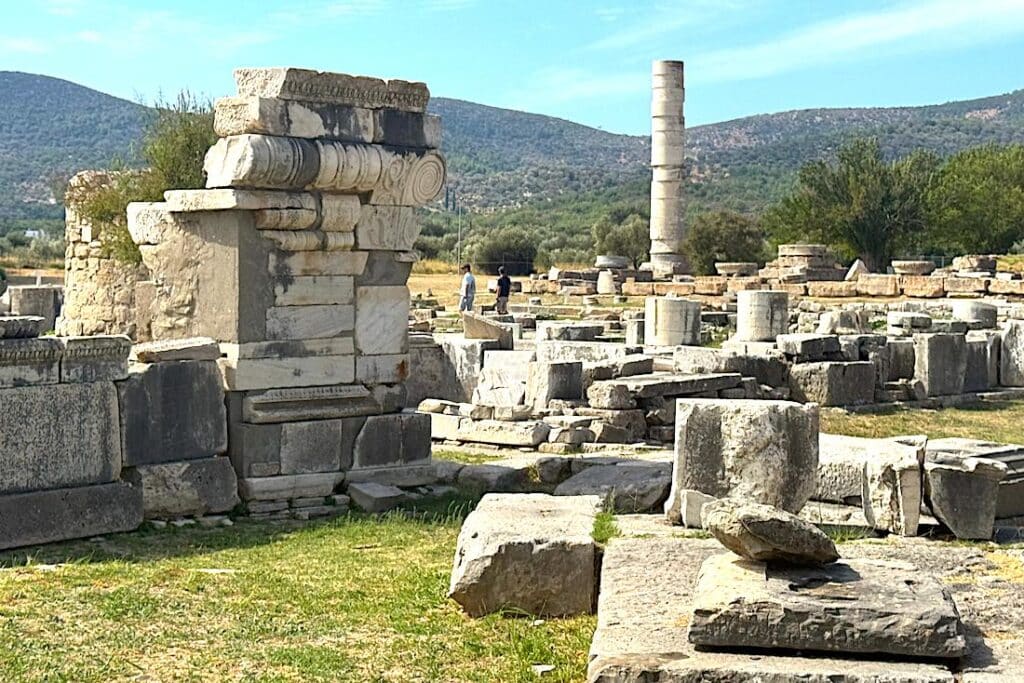
The Heraion of Samos, dedicated to Hera, was among the most important sanctuaries of ancient Greece, as legend claims the goddess was born there. Hera, the wife of Zeus, was the goddess of marriage, women, family, and childbirth.
Situated six kilometers (over 3.5 miles) from the ancient city of Samos, present-day Pythagoreio, the sanctuary was politically and administratively connected to the city. Pilgrims reached it either by traveling along the Sacred Way or by sea, and it stands in the fertile plain formed by the alluvial deposits of the Imvrasos River.
The temple of the late Archaic period was the first monumental free-standing Ionic temple, constructed on a swampy site that constantly posed structural challenges. According to legend, the goddess was born beneath a willow tree on the riverbank, which became her sacred tree. Despite these difficulties, the ancient Samians repeatedly rebuilt temples on the same location, demonstrating the deep connection between the worship of Hera and this specific piece of land.
The cult of Hera on the island of Samos is documented from the late Bronze Age, particularly during the Mycenaean civilization (1600 to 1100 BC). According to archaeological findings, religious activities took place at the site as early as around 1700 BC. Revered as the Mother Goddess, Hera was the “mother of all things,” as described by the poet Alcaeus.
The first cult statue of Hera was made of wood (xoanon). According to Pausanias, it was brought to Samos from Argos by the Argonauts, who founded her cult. Both women and men served as custodians of this important sanctuary of ancient Greece, and the presence of peacocks—sacred to the goddess—formed a distinctive and enduring feature of her cult.
Early history of one of the most important sanctuaries of ancient Greece
The remains of a prehistoric settlement uncovered during excavations to the north and northeast of the great temple, and north of the Sacred Way, indicate that the sanctuary consisted of megaron-shaped houses built with unbaked bricks around 2200 BC, surrounded by a protective wall. These remains have since been buried to ensure their preservation.
During the Mycenaean period, the area contained a small stone altar, a temple-shaped structure built to house and protect the wooden cult statue, and a willow tree, which was considered sacred to the goddess.
The sanctuary retained its significance even after the Ionian colonization of the island around 1100 BC. A few finds from the Proto-geometric and Early Geometric periods suggest that the cult existed on a limited scale during this time. A notable development occurred in the 8th century BC, when the altar was redesigned as a rectangular structure and surrounded by paving.
The first temple of Hera was constructed west of the altar and is known as Hekatompedos I, a name meaning “hundred-footed” in reference to its length of one hundred feet and its length-to-width ratio of five to one. Its walls were made of bricks resting on a low stone platform, and its tiled saddle roof was supported by a series of wooden beams. In the 7th century BC, following the destruction of the first temple, Hekatompedos II was built with a stone platform and a wooden perimeter, and the altar was also renovated.
The major reform of the sanctuary on Samos, Greece
A major reform of this important sanctuary of ancient Greece took place in the middle of the 6th century BC. Between 570 and 560 BC, the sculptor Rhoecus and his son Theodorus designed, founded, and supervised the construction of the enormous Temple of Hera, which was built over Hekatompedos II. The new temple was dipteral, meaning it had a double row of columns surrounding the central structure, with dimensions of 52.5×10⁵ meters (57.5×115 yards).
Inside the temple, columns divided the nave—the central hall—from the pronaos, the front porch or vestibule of the temple, creating three aisles. The remarkable ribbing of the columns was made on soft limestone using a rotary wheel invented by Theodorus. The columns, estimated to have been 18 meters high, were made of poros stone and ribbed, while the cornice was wooden, and the roof was covered with fired tiles ending in wreathed decorative tiles.
The temple was celebrated as a marvel of Ionic architecture, but it was destroyed by an earthquake only a few years after its completion. During the tyranny of Polycrates, construction began on an even larger temple. Herodotus described it in Histories in 460 BC as “the largest temple of all the temples we have seen.”
The new Temple of Hera was also dipteral, with dimensions of 55.16×108.63 meters (60×118.8 yards). The increase in size compared to the temple of Rhoecus resulted from the addition of another row of columns, bringing the total number to 155. Today, only a portion of one column on the south side survives in its original position. The original height of the columns reached twenty meters.
Columns were made of marble, while the rest of the building was constructed from limestone. Bases were decorated with horizontally ribbed spirals and tori, trunks remained smooth, and tops were encircled by carved decorative bands with color. The outer capitals followed the Ionic style, featuring helices and floral motifs, whereas the inner capitals displayed a continuous band of egg-shaped decorations. Furthermore, the walls of the pronaos were likely adorned with sculpted figures, and the entablature would have been made of wood.
The decline of Samos
Scholars believe that this Temple of Hera was never fully completed. After the death of Polycrates in 522 BC, internal disputes among his successors led to the economic and political decline of Samos. Much of the temple’s building material was likely repurposed for the construction of the city walls and other structures, and worship remained centered on the monumental altar, which measured 36.5×16.5 meters (40×18 yards). The original superstructure was made of light-colored limestone.
When Athens occupied Samos in 439 BC and many Samians were exiled, Athenian priests settled on the island, introducing the worship of their own gods. Economic recovery, and with it renewed building activity at the Heraion, occurred after 322 BC with the return of the Samians, following a decree of Alexander the Great that was implemented after his death. Construction on the Temple of Hera resumed at that time.
During the Hellenistic period, the sanctuary became a stage for Samian politicians to display their status. Belief in the traditional Greek gods gradually declined, and new deities of eastern origin, such as Cybele, Isis, Ammon Zeus, Anubis, and Serapis, began to appear within the sanctuary.

Samos under Roman rule
In the 1st century BC, Samos became a Roman province. Following the end of the Roman civil wars in 31 BC, the Heraion experienced a period of renewed activity. During the reign of Octavian Augustus, the Samians erected a temple in his honor, as well as in honor of Rome, and work on the temple and altar of Hera continued. The large temple became a repository for older votive offerings, and a pavilion temple was constructed to house the cult statue.
The altar, a courtyard surrounded on three sides by a protective wall ranging from five to seven meters (5.5 to 7.7 yards) in height, ended in a wave-like design. Inside, it featured a relief frieze depicting beast fights and sphinxes, and the ends of the wall were adorned with richly decorated capitals. The upper surface was covered with a slab of refractory green ophiolite, where oxen were sacrificed, as indicated by the numerous ox bones uncovered during excavation.
At the same time, the archaic altar was renovated using marble. Evidence suggests that Livia, the wife of Augustus, was worshiped at the Heraion after her death alongside the goddess Hera, according to a surviving inscription.
By the late 1st to early 2nd century AD, the sanctuary again fell into decline. In the middle of the 2nd century AD, a Corinthian temple measuring 7.4 by 12 meters (7.7 by 13.1 yards) dedicated to an unknown deity was constructed on the site. In the 3rd century AD, the last temple was built with a rectangular pedestal of cast masonry featuring wave motifs above and below.
One of the most significant projects of the 2nd and 3rd centuries AD was the paving of the Sacred Way with slabs. From the end of the 2nd century AD onward, much of the site became covered with houses—one- and two-story structures featuring small peristyle courtyards, mosaic floors, and water supply and sewage systems. The settlement’s inhabitants also had access to a small hot bath facility.
The first basilica on the site and the Christian era
The devastating earthquake of 262 AD, combined with plundering by Germanic tribes, led the settlers to abandon the site. By the 4th century AD, the ancient buildings had been demolished, and their building materials were sold in Asia Minor.
In the 5th or 6th century AD, as Christianity became the official religion of the Byzantine Empire, a three-aisled early Christian basilica was constructed on the site, incorporating ancient architectural elements and fragments of votive offerings. This basilica was destroyed by the end of the first millennium AD, and in its place a cruciform basilica with a dome was built in the 16th century. The arch that survives on the site today belongs to that later structure.
Christian worship persisted on the site until the 18th century, when a small chapel was built. This chapel was later demolished to make way for archaeological excavations. Surrounding it stood remnants of earlier structures once dedicated to various Greek deities. The Sacred Way, which led to the heart of the sanctuary, was lined with a dense array of important monuments and offerings.
Statue complexes and masterful works such as the celebrated group by the sculptor Geneleos adorned this sacred route, while colossal marble kouroi stood sentinel along the path, guarding the sanctuary as timeless symbols of devotion and artistic excellence.

Unique archaeological findings
The artifacts unearthed at the Sanctuary of Hera are among the most remarkable discoveries of ancient Greece. Thanks to their exceptional state of preservation, they are considered some of the most important finds of antiquity. A selection of these treasures is now displayed in the Archaeological Museum of Vathi on the island of Samos.
These invaluable offerings, crafted by the faithful from clay, copper, wood, steatite, ivory, faience, and limestone, reflect the wide-reaching influence of the Heraion of Samos and its importance as a hub of cultural exchange in the ancient world. Their historical and artistic significance ultimately led to the inclusion of the Heraion archaeological site on the UNESCO World Heritage List.
Business Wire



No comments