


How Ancient Greeks Harnessed Winds to Defeat the Persians at the Battle of Salamis
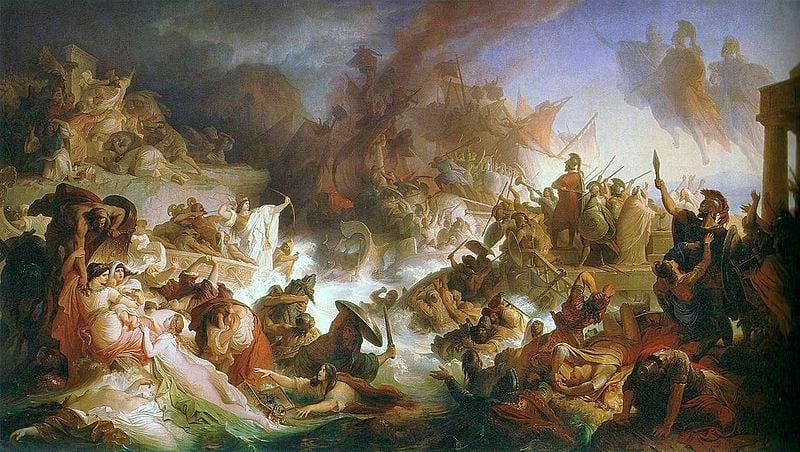
The Battle of Salamis, fought between the Persians and a vastly outnumbered Greek force in September of 480 BC, is considered by many historians to be one of the most decisive in history.
A research from the Center for Atmospheric Physics and Climatology Research at the Academy of Athens argues that the Greeks actually chose the site of Salamis after studying the area’s climactic conditions.
This hypothesis is a groundbreaking development regarding one of the most well-studied and famous battles in world history.
Had the Greeks not won the battle, many believe that the Persian invasion of Greece would have been successful, altering the course of history as we know it.
Greeks used wind, weather to win Battle of Salamis
Classical Athens, which gave us the foundation of Western culture, including philosophy, literature, and democratic government, only bloomed after the Greeks finally won the Persian wars after many battles, both on land and sea.
Much like the Battle at Thermopylae, the heroics at the Battle of Salamis have risen to legendary status, as the allied Greek city-states used approximately 370 trireme ships, and the Persians had over 1,000, according to ancient sources.
The Persians, under King Xerxes, planned to crush the outnumbered Greeks with the sheer force of their massive fleet. The leader of the Greek ships, Themistocles, aware of the number of Persian ships, lured the Persians to the narrow Strait of Salamis, where the Greek ships were waiting.
Since the massive Persian fleet could not fit in the strait, they quickly became disorganized, opening up a possibility for a Greek victory.
It was not only the great military mind of Themistocles which led the Greeks to victory, but also a deep knowledge of the climate of Salamis, according to an article published in the scientific journal Atmosphere by researchers at the Academy of Athens.
In the study, led by Professor Christos Zerefos, researchers argue that current data gathered regarding wind conditions in the Strait of Salamis align with ancient eyewitness accounts.
Additionally, the study contends that the Greeks must have been aware of these conditions, as Greeks planned a late-morning attack on the Persians, which aligned with wind conditions that made it more difficult for the Persians to retreat into the open sea in the early afternoon.
Late-night and early-morning northwest winds, or Etesian winds, in the Saronic Gulf, combined with local south sea breezes in the late morning, trapped the Persian fleet in the narrow Strait of Salamis during the afternoon, leading to a Greek victory in the early evening.
This particular wind pattern is still present today, and takes place mainly from May to September, when the sun is especially strong, heating up the atmosphere. The Battle of Salamis is traditionally believed to have taken place at the end of September in 480 BC, when this weather phenomenon is still in effect.
Business Wire



No comments