


The Hidden Code Behind Ancient Greece’s Enduring Civilization
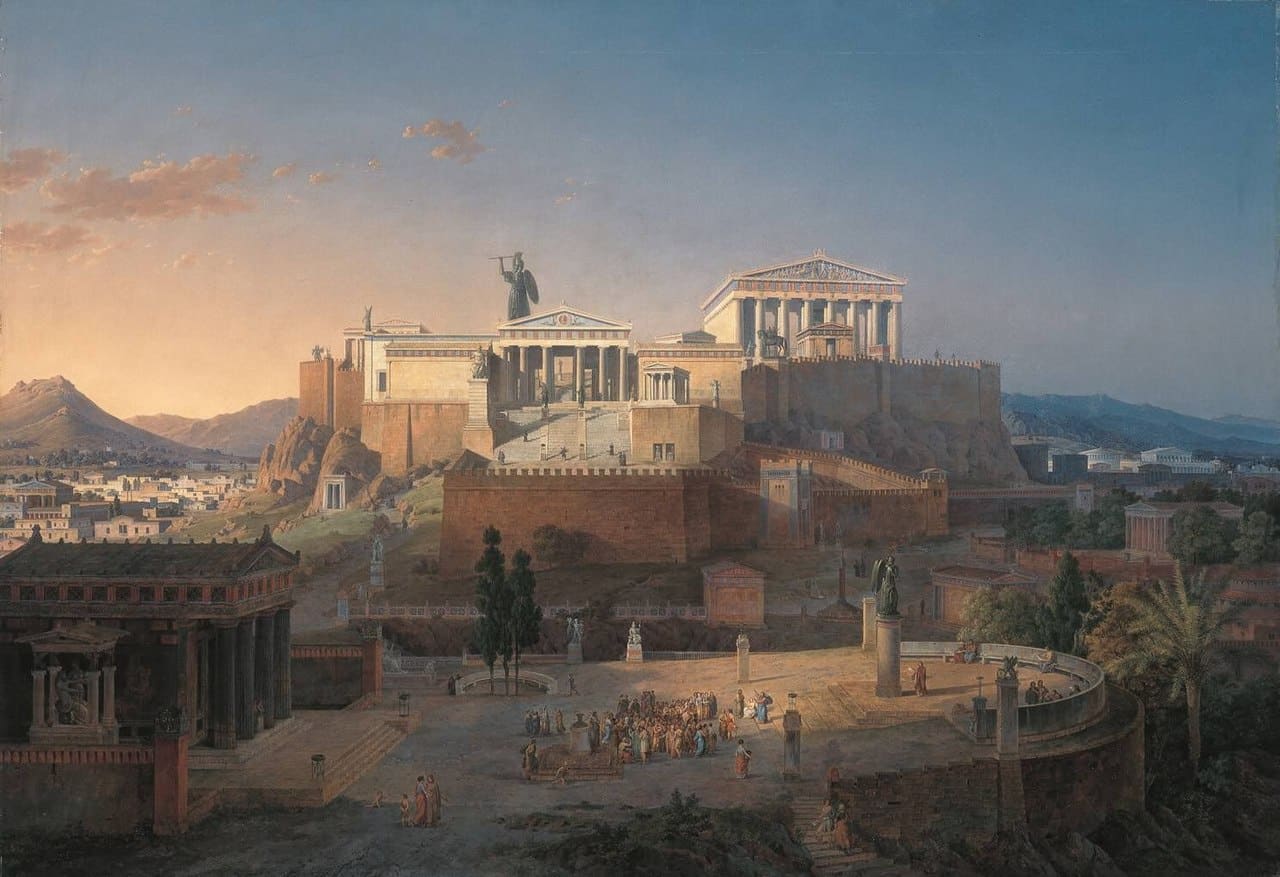
Ancient Greeks encoded the secrets of their civilization in ways hidden in plain sight, shaping a legacy that endures through millennia.
By Ryan Kralik
Many of civilization’s most recognizable roots can be traced to Greece. The stones of the Acropolis, the words of Plato, the myths of Olympus—each was a fragment of something larger: a people learning how to make themselves last.
Ancient Greece stands as a defining epoch in the evolution of civilization’s memory systems. While earlier societies etched their legacies in the enduring bones of stone monuments—Göbekli Tepe’s sealed pillars, Stonehenge’s celestial calculators, the pyramids’ stellar signatures—Greece introduced a new paradigm: encoding cultural persistence through abstraction, logic, and symbolic precision. This moment marks the penultimate transformation in how civilizations encode endurance before the dawn of the modern age.
When people call Greece the cradle of the West, they usually mean democracy, philosophy, and art. But Greece’s deeper brilliance was structural. It discovered how to encode meaning into matter—how to make culture itself coherent and self-preserving. From the Parthenon to the polis, from Homeric epic to Euclidean geometry, Greece didn’t just build monuments or record thoughts. It built systems that could remember.
In his forthcoming book It From Us – An Information-First Framework and the Purpose of Consciousness, the author argues that reality is not fundamentally made of matter but of information. The patterns that persist—from atoms to galaxies to civilizations—are those that organize meaning and resist entropy. Greece offers history’s clearest early example of that universal bias toward coherence. It became, in effect, the first great information system built by human hands.
From stone to symbol
Prehistoric and early historic cultures encoded communal memory mainly in physical media—massive stones, monumental earthworks, and aligned temples designed to resist time’s entropy. Such monuments, while effective as “hard drives” of cultural memory, were costly and largely static.

The Parthenon is not merely a temple; it is information carved in marble. Its columns lean inward to correct the eye, its steps rise in subtle arcs, its proportions trace the geometry of harmony. To the Greeks, beauty and truth were not separate virtues but expressions of the same order. Each line of marble encoded an idea: that the universe is intelligible, that perfection can be approached through ratio. The Parthenon endures not because its stones are strong but because its pattern is perfect. Even in ruin it transmits its message—coherence is truth, and truth endures.
The physical design of Greek spaces reinforced informational flow. The agora was an open interface—part marketplace, part debate chamber, part rumor mill. Information moved freely there, and through that motion coherence self-corrected. Tragedy and comedy performed similar work, stress-testing social code through dramatized failure and catharsis. Every civic ritual was feedback—society debugging itself in public.
In every Greek city, architecture served the same purpose. Amphitheaters carried the human voice across thousands of seats. Temples aligned with celestial events, binding the heavens to the human world. The built environment was both medium and message: form as meaning, meaning as memory.
Myth as cultural code
Greek persistence systems adapted from static monuments to dynamic social and intellectual networks. Oral traditions were harnessed through dialectic methods, designed for continuous testing and refinement—foreshadowing modern scientific protocols.

Greek myth did for story what architecture did for form. It turned experience into
compression—vast meaning stored in compact narratives. Zeus, Athena, Prometheus—these were not simply gods but processes, embodiments of natural and moral law. Prometheus stealing fire is the spark of knowledge itself, the dangerous gift of awareness. Athena, born from the mind of Zeus, is wisdom arising from order. Each myth encoded a rule for coherence, a guide to what must persist.
Myths were not only told but replicated—sung, staged, carved, and painted. Every performance re-encoded the civilization’s essence. In an age before printing or digital storage, mythology was replication code—redundant, symbolic, error-correcting. The Greeks found in story the same law my information-first framework describes: information seeks persistence through repetition, replication. This shift from mythic stories to symbolic algorithms radically enhanced civilization’s capacity to sustain, propagate, and manipulate knowledge, opening new dimensions on cultural endurance.
Language as the medium of memory
The Greek alphabet transformed communication into precision. It captured sound rather than symbol, making meaning teachable, portable, and permanent. Where Homer’s epics were an oral code—transmitted from mind to mind, stabilized by rhythm and repetition, when finally written, the knowledge of an entire culture became permanent. Writing made thought durable.
Laws could be inscribed, discoveries preserved, debates revisited. Speech became structure; thought gained a physical body. The Rosetta Stone stands as a perfect symbol of Greece’s role as civilizational bridge. Inscribed in three scripts—hieroglyphic, demotic, and ancient Greek—it was the Greek text that unlocked the meaning of Egypt’s lost language. Without Greek, the voices of a civilization millennia older would have remained silent. In this way, Greece not only preserved its own memory but connected epochs, serving as the decoder ring of human history—translating not just words, but worlds.
Through language, Greece showed that the universe’s drive toward stable patterns can be mirrored in human culture. Words became the substrate through which identity itself could be stored and retrieved.
Philosophy as the architecture of thought
Greek philosophy didn’t just survive history; it became history’s foundation. The inquiries of Plato, Aristotle, and their successors form the conceptual scaffolding beneath modern science, ethics, and governance. Logic, first formalized in the Lyceum, underpins computation and mathematics; Aristotle’s metaphysics still echoes in debates over consciousness and reality; and Socratic questioning remains the heartbeat of democratic discourse.

Even when its language was lost to scholars in the West, Islamic philosophers like Avicenna and Averroes safeguarded and expanded Greek thought, reintroducing it centuries later through translation and commentary. Every time a student asks why, or a scientist tests a hypothesis, they are unknowingly participating in the same process Greece encoded millennia ago—the pursuit of coherence through reason.
From Thales to Aristotle, Greek thinkers searched for what stayed constant amid change. Heraclitus spoke of the logos, the pattern behind becoming. Pythagoras found number and ratio in the harmony of the cosmos. Plato described ideal forms beneath perception. Aristotle mapped the logic of being itself.
These weren’t simply abstract musings; they were early attempts to model the informational nature of reality. The Greeks were building a mental architecture—a logic of persistence. They intuited that coherence, not chaos, drives existence. Philosophy became the software of civilization, a self-correcting code that could survive translation and time.
Knowledge networks as living persistence
Libraries and catalogues—most famously Alexandria’s—served as centralized repositories, but their true power lay in establishing standards for symbolic encoding of information, facilitating cross-generational transmission beyond mere material durability.
Greek culture expressed its persistence through the intertwining of two fundamental modes of encoding memory and identity. The first was mythos, the realm of narrative and ritual, where myths and ceremonies redundantly encoded social and ethical coherence. This mode anchored identity in culturally powerful stories rich with emotional resonance, ensuring that fundamental values and collective experience endured not only through logic but through shared feeling and tradition.
Complementing this, the Greeks developed logos—the rational, conceptual encoding expressed through philosophy, science, and political theory. Logos distilled cultural payloads into abstract, compressed frameworks designed for scalable transmission, refinement, and logical evolution. Together, mythos and logos formed a layered, resilient system that balanced redundancy with compression, memory with innovation, securing the endurance of Greek civilization’s essence through multiple complementary channels.
This dual coding offers a robust strategy, recognizing that persistence demands both redundancy (social cohesion) and compression (conceptual clarity). Their interplay sustained cultural memory despite upheavals and transformations.
Democracy as distributed memory
Democracy was Greece’s boldest encoding. Not merely a political experiment, it was a living algorithm for truth maintenance. In an informational universe, coherence improves when inputs diversify. The Athenians, consciously or not, instantiated that principle in governance: they distributed decision-making across many nodes. The ekklesia, the public assembly, functioned like a neural network—thousands of citizens contributing weighted inputs, correcting error through deliberation. It wasn’t equality as morality; it was redundancy as stability.
Where monarchy stores power in a single data point and tyranny in a corrupted loop, democracy diffuses its data across the system. It sacrifices efficiency for error correction—the same logic that underlies resilient computation. In the Greek context this was radical, but at the informational level it was inevitable. A civilization tuned to coherence would eventually attempt distributed processing.
The architecture of the polis mirrored this pattern. Each city-state was autonomous yet interoperable—sharing language, myth, and exchange protocols. The Greek world functioned as a decentralized network before the term existed. When Persia invaded, the signal held because no single node could be erased without the others retaining the code. When Alexander carried that code east, it replicated through hybridization—Hellenism as viral encoding.
Modern democracies, for all their flaws, still run on this ancient operating logic. Parliamentary systems, open courts, freedom of speech—these are not moral achievements but informational optimizations. They maximize signal bandwidth, minimize corruption, and ensure that the shared reality doesn’t collapse into local distortions. When democracy falters, as it does in cycles, the problem isn’t the ideal but the loss of informational hygiene—noise overtaking signal. Greece saw that risk too; they called it ochlocracy, the rule of noise.
The survival of the democratic code proves its informational fitness. Tyrannies burn bright and brief because they rely on suppression—an energy-intensive task in any system. Democracies, though chaotic, self-heal. They absorb error by allowing contradiction. That’s how information survives. Two and a half millennia later, we still use the same syntax: vote, argue, amend, repeat. The process matters more than any outcome. It’s the encoding of continuity itself.
Civilization as code
Across nature and culture alike, the same rule holds: what persists is what coheres. Greece embodied that rule with conscious artistry. Its architecture fused ratio and reverence; its myths carried knowledge through emotion; its language fixed abstraction; its philosophy formalized logic; its politics spread memory across the population. Each layer reinforced the others until the entire civilization became a single, interlocking memory system.
Rome conquered Greece militarily but absorbed its code. Byzantium preserved and translated it. Renaissance Europe recompiled it. The pattern still runs today—in our architecture, language, ethics, and science. That is the mark of a system built not just of stone or words but of information that endures.
Seen this way, Greece was more than a birthplace of culture. It was the first demonstration of a universal principle: that the universe favors persistence, and that meaning, once encoded coherently enough, can survive the fall of empires. Civilization’s first hard drive wasn’t silicon—it was marble, myth, and mind.
As modern civilization confronts the challenges of preserving digital information in a rapidly entropic technological landscape, Greek lessons resonate strongly. The shift from physical to symbolic persistence confirms the imperative to build recursive validation and compression techniques to ensure longevity. Understanding Greece through an information-first lens reveals how civilizations encode endurance: initially in stone and ritual, then in logic and abstraction—and ultimately within the interplay of both, allowing memory to transcend generations and epochs.
Ryan Kralik is a writer and researcher exploring how civilizations encode meaning and memory across time.
His forthcoming book, It From Us – An Information-First Framework and the Purpose of Consciousness, proposes that information, not matter, is the foundation of reality, linking the physical, biological, and cultural forces that shape existence. His work examines how coherence, from atoms to empires, determines what endures and why. Learn more at ItFromUs.com.
Business Wire



No comments