


Hidden Treasures, a Vanished Monastery, and a Mysterious Explosion Shroud Greece’s Kalogeroi Islands

The Kalogeroi islands of Greece (from kalogeros, meaning “monk” in Greek) are two isolated landforms in the Central Aegean, situated 25 miles northeast of the island of Andros and 24 miles southwest of Antipsara. Chios lies 27 miles to the east, while Skyros is 46 miles north. The larger of the pair is called Great Kalogeros, and the smaller, Little Kalogeros.
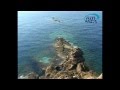
Today, Great Kalogeros rises 36 meters (118 feet) above the sea. It is barren of vegetation, and from a distance of nine miles to the northeast, it resembles a sailing ship. Waves and strong winds batter the island mercilessly, and calm days are few and far between. The name “Kalogeros” appears in six different locations throughout the Greek seas. Sailors generally gave this name to isolated, rocky islands, as if they were hermit monks.
On Great Kalogeros, the scant remains of a hermitage-monastery remind visitors that hermit monks once inhabited these inhospitable rocks. In earlier times, the monks depended on passing ships for their food, which they hoisted up to the hermitage in baskets. It is also said that people entrusted their money and valuables to the isolated monastery for safekeeping.
Legend has it that pirates hid their loot on the Kalogeroi islands in Greece so that it would be challenging to access, and it is possible they traded with the monastery. During the German Occupation, the Nazis reportedly stored arms and ammunition on Great Kalogeros. Approximately eight-tenths of a mile northeast of the larger island lies Little Kalogeros, which has now been reduced to scattered rocks situated only just over three feet above sea level.

Volcanic debris on the Kalogeroi islands of Greece
Great Kalogeros covers about 6 acres and has a coastline of 302 meters (990 feet). Roughly 1,400 meters (4,600 feet) to the northeast lies Little Kalogeros, now barely rising 1 meter (3.3 feet) above sea level, with shallows stretching southward for about 100 meters (330 feet).
Both of the Kalogeroi islands of Greece are volcanic in origin, and over the centuries, they have served as target sites for naval exercises, leaving behind scattered shell fragments still visible to this day. “During the population census of October 16, 1940, it (Great Kalogeros) was reportedly inhabited by six residents,” notes Georgios K. Yiagakis in Census of Inhabited Greek Islands 1940–1991. “They were shot by men, probably from the Navy, who were monitoring the area in anticipation of an Italian attack during World War II.”
In 1920, an automatic lighthouse was installed on Great Kalogeros to help ships steer clear of the hazardous rocks. Reaching the island, however, remains hazardous. The surrounding waters drop steeply to depths of over 70 meters, even close to shore, and the strong currents make navigation dangerous. A chain of sudden shallows to the southeast adds to the peril, often catching boats off guard.
The only marginally safe anchorage lies on the southern side of the island, yet even there, caution is essential. Waves from passing vessels can make conditions treacherous, even when the winds are calm. For most visitors, the safest—and perhaps most awe-inspiring—experience is to remain aboard and simply admire the stark, untamed beauty of the Kalogeroi from the sea.
The perilous climb to Great Kalogeros, Greece, leads to a world of blue
Climbing to the summit of Greece’s rugged Great Kalogeros along its precarious stone steps is treacherous. Many of the steps were carved directly into the rock in ancient times, but centuries of wind, water, and erosion have nearly eroded them entirely. The rocks crumble easily underfoot and are dangerously slippery. Yet, those brave enough to attempt it can reach the top within ten to fifteen minutes.
The ground is strewn with shells and bullet casings, silent reminders of the two world wars of modern times. Over the decades, these have become embedded in the rock crevices, merging with the island’s rough surface and its turbulent history.
At the summit, an iron lighthouse stands on the foundation of the old stone one, beside the ruins of what was likely a later military outpost. The view from above is breathtaking—the sky and sea blend into a single vast expanse, an endless Aegean blue that seems to merge the elements into one.
The mysterious disappearance of a monastery on Greece’s Great Kalogeros island
An old building atop Great Kalogeros has fascinated geographers and travelers since antiquity. For Pliny the Elder, Great Kalogeros may have been identified as another island of Greece, Skopelos. The first of the more recent geographers and travelers to document the island was the Florentine priest Cristoforo Buondelmonti in 1420.
On 16th- and 17th-century maps, Great Kalogeros is shown north of the Tinos Strait, roughly halfway to Chios. Atop this isolated rocky peak, a monastery was constructed in the style of late-Byzantine hermitages, likely in the 15th century, as Bartolomeo Dalli Sonetti encountered the island and included it in the illustrations of his Isolario of 1485. From that point onward, almost all cartographers noted the unusual shape of Great Kalogeros. Yet, by the mid-17th century, this remote, arid rock and its monastery vanished. On maps from 1658 to 1950, Great Kalogeros appears simply as a steep, rugged rock surrounded by smaller islets.
In the southern part of the island, a small plateau near the sea once held a few buildings, though the island’s steep coasts made climbing difficult. At the summit, a larger plateau formed the site for the monastery and several houses. Many depictions of the Kalogeroi islands show buildings and cultivated plots nearby. For instance, in the 1688 copper engraving by Piancenza, fortifications with a round tower are visible, along with structures on two neighboring southern islets labeled “Chirana” and “Lesindra.”
The large crane, a distinctive feature of the island of Great Kalogeros
A distinct feature of Great Kalogeros, visible in nearly all depictions of the island, was a large crane on the eastern side beneath a balcony. In some illustrations, it appears wooden, while in others it looks like a natural extension of the rock.
The crane was used to raise and lower boats, serving as the islanders’ primary means of communicating with passing ships and neighboring islands. In this way, Kalogeros functioned much like a “Meteora in the sea”: when the crane was raised—their only way to transport supplies and maintain contact—the island became a virtually impregnable natural fortress.
Descriptions of the island also highlight the monastery’s accumulation of goods, much of it coming from Aegean Sea merchants. Whether these goods were obtained through trade—often indistinguishable from piracy at the time—or entrusted to the monastery for safekeeping, it is clear that Kalogeros amassed significant wealth from both “legal” and “illegal” maritime activity. During that era, however, it was common for monasteries to protect the property of Christians and engage in the sale of goods, making such practices socially and economically acceptable.
A mysterious explosion demolishes one of the Kalogeroi islands in Greece
Several engravings of the intriguing island of Great Kalogeros in Greece and its story appeared in Europe during the 17th century. In 1687, the English traveler Bernard Randolph, in his book The Present State of the Islands in the Archipelago (Oxford, 1687), writes that while passing through Smyrna, he heard of an inhabited islet called Kalogeros, located between Andros and Chios, and of a strange explosion in which most of the island collapsed and all its inhabitants were killed. He does not, however, specify the cause of this mysterious event.
Randolph adds: “I heard many merchants of Smyrna say that their money and seals lost their value when the island was blown up. Many rocks were blown as far as Tinos and Andros! Only a very small part of the island remains today.” Notably, Randolph was otherwise meticulous in his descriptions of other islands, yet he makes no mention of a monastery, even though the contemporary image of Vincenzo Maria Corenelli (1650-1718), particularly noted for his detailed maps and globes, clearly depicts one.
Randolph’s account may find support in the writings of the French traveler André Thevet, who claims that the 12th-century Byzantine chronicler Joannes Zonaras spent five years on Kalogeros of Andros, where a monastery existed. Thevet also hints at the economic significance of the island, indicating that wealth had accumulated there.
One possible explanation for the explosion that destroyed the island is volcanic activity. On September 1650, a major earthquake struck Santorini, measuring 6.8 on the Richter scale and VIII (8 points) on the Mercalli scale. The earthquake, accompanied by an underground volcanic eruption, sent ash as far as Asia Minor, coating leaves with a fine layer of volcanic dust. Randolph also notes that in Smyrna, many metal objects and utensils blackened following the disaster, corroborating the volcanic explanation.
The story of the Kalogeroi islands later captured the attention of Sir Francis Beaufort, the Irish hydrographer and naval officer who created the Beaufort Scale for measuring winds. Beaufort visited the windswept area in 1812 and drew what remained of the mysterious island; his sketch was published in 1819 by the English Admiralty.

He was among the few to record even a partial history of the rocky islands at the heart of the Archipelago. The full story of the Kalogeroi islands—the monastery, its wealth, and the pirates—is now largely lost to the Aegean Sea’s depths, remaining a mysterious chapter in the region’s history.
Business Wire



No comments