


The Catalan Secret That Allows Spain’s King to Be the Duke of Athens, Greece
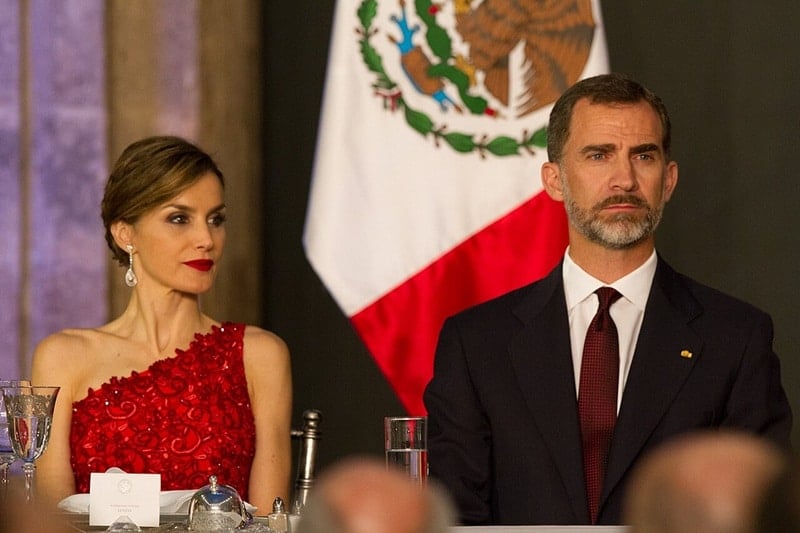
The King of Spain holds more than just his familiar throne—he also carries the historic title of Duke of Athens, a surprising connection that underscores the centuries-long influence of Catalans in Greece. King Felipe VI of Spain exemplifies this curious legacy.
Alongside his role as King of Spain, he is technically the Duke of Athens and the Duke of Neopatras. At first glance, it seems like an error—why would a modern monarch in Madrid have any claim to the Greek capital? Yet these titles are far from imaginary. They are ceremonial remnants of a Catalan conquest that reshaped parts of Greece in the Middle Ages, preserved through centuries of tradition and royal record-keeping. Though largely symbolic today, they offer a fascinating glimpse into how history, power, and prestige intertwine across borders and eras.
The story of the Catalans in Greece
This quirky constitutional formality actually stems from a remarkably bloody 14th-century medieval mercenary land grab. To understand it, we need to look beyond the modern Spanish state. The Spanish Crown has never been a single, continuous entity; rather, it is more like a sprawling historical anthology, absorbing the chaotic legacies of long-gone kingdoms.
The story begins with a massive power vacuum. In 1204, the Fourth Crusade had shattered the once-mighty Byzantine Empire. By 1303, Byzantine Emperor Andronikos II Palaiologos was desperate to stave off catastrophe. He urgently needed military support against advancing Turkish forces and rival Frankish lords, so he hired a notoriously fierce band of Iberian mercenaries known as the Almogavars, the backbone of the Grand Catalan Company.
This force numbered roughly 6,500 heavily armed men, accompanied by their families. Brutally effective in combat, they were also nearly impossible to control. Following a bitter dispute over pay and the assassination of their commander, these mercenaries turned on their Byzantine employers. They carved a path of destruction through Thrace and Macedonia before eventually pushing south into Central Greece.
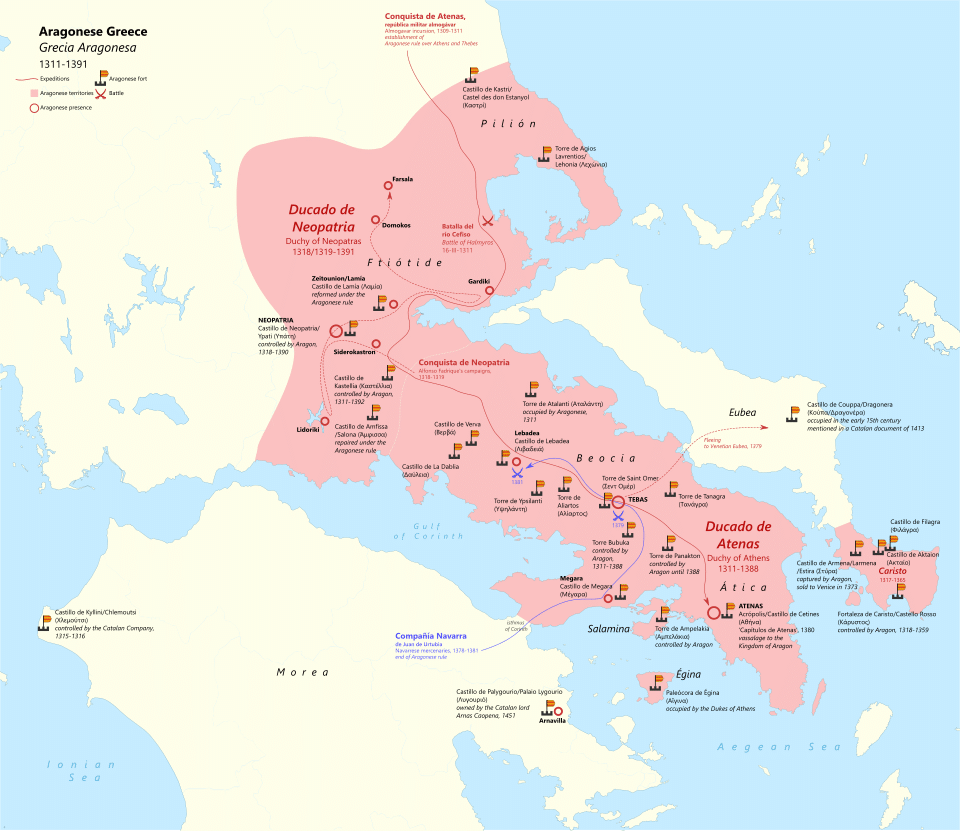
This was the moment the Catalans decided to push their plans further. In the spring of 1311, the heavily outnumbered mercenaries faced off against the arrogant French knights who controlled the Duchy of Athens. At the Battle of Halmyros, they executed a brilliant, if ruthless, tactical maneuver, luring the heavily armored French cavalry straight into a marshy swamp. The resulting slaughter was total. With that victory, the mercenaries claimed the Duchy of Athens, and by 1319, they had advanced north to establish the Duchy of Neopatras in what is now Central Greece.
However, taking territory by force was only half the battle. Europe’s powers weren’t about to recognize a land grab without legitimacy. To secure protection from the Byzantines and the French, the Catalans pledged their newly conquered territories to the Crown of Aragon. By swearing allegiance to the Aragonese kings, these rogue fighters transformed their Greek conquests into official provinces of a major European power, the historical predecessor of Spain.
It was not until 1381 that King Peter IV of Aragon formally adopted the titles of Duke of Athens and Neopatras. In practice, however, the Aragonese held the lands only briefly. By 1388, a wealthy Florentine family financed an army that expelled them, and shortly thereafter, the Ottoman Empire swept through the Balkans, permanently ending Western European control in the region. Yet the Crown of Aragon steadfastly refused to relinquish the titles it had so formally embraced decades earlier.
At the time, royal prestige relied more on dynastic memory and ceremonial prestige than on actual territory. When the crowns of Aragon and Castile merged in 1469 through the marriage of Ferdinand and Isabella, the foundations of modern Spain were laid. The Greek titles became ceremonial heirlooms—detached from any physical land or political reality but permanently embedded in the monarchy’s legal identity.
Why the King of Spain is still technically the Duke of Athens
Today, these titles exist in a curious space between historical legacy and modern law. Under Article 56.2 of Spain’s 1978 Constitution, the king is legally permitted to use all historical titles associated with the Crown. This means King Felipe VI could formally style himself as the Duke of Athens if he wished.
In practice, however, the designation is purely symbolic. The Spanish monarch holds no sovereignty, political authority, or tax claims over contemporary Greece, and the title does not create any diplomatic friction between the two countries. Instead, it stands as a fascinating quirk of Mediterranean history—a reminder of the intricate and often unpredictable legacies left behind by medieval geopolitics.
Business Wire



No comments