


Monemvasia: Greece’s Castle Town Where Easter Becomes a Mythical Experience

Glistening like a jewel under the sun of Greece and surrounded by the vast, deep blue waters of the Myrtoan Sea near the tip of the Peloponnese, Monemvasia encompasses all the stuff myths are made of.
Its cobblestone, narrow streets, and alleys, the castle and its walls, the sea, and the bright pink bougainvilleas gracefully adorning its medieval buildings during springtime, are all elements immortalized by famous Greek poet Yiannis Ritsos, who was born in Monemvasia, throughout his acclaimed verses.
But Easter is when Europe’s oldest continuously inhabited castle town metamorphoses into a solemn, mythical scene, where tradition and folklore combine so visitors can experience what we truly call “Greek Easter.”
In Monemvasia, you can witness one of Greece’s most moving Epitaphios (Bier of Christ) processions. It has been taking place for hundreds of years in the cobblestone streets of the medieval castle town.
On Holy Friday or Good Friday, the Epitafios, once it exits the church, starts going through the eastern side of the town, with a band ahead of it playing mournful songs, ending at the church of Virgin Mary The Chrysafitissa, one of the dozens of Byzantine churches inside the castle town. The faithful follow along the narrow streets, holding candles. At the same time, the chanting of prayers resonates across the massive, untamed rock where Monemvasia is built, offering a unique acoustic beauty.
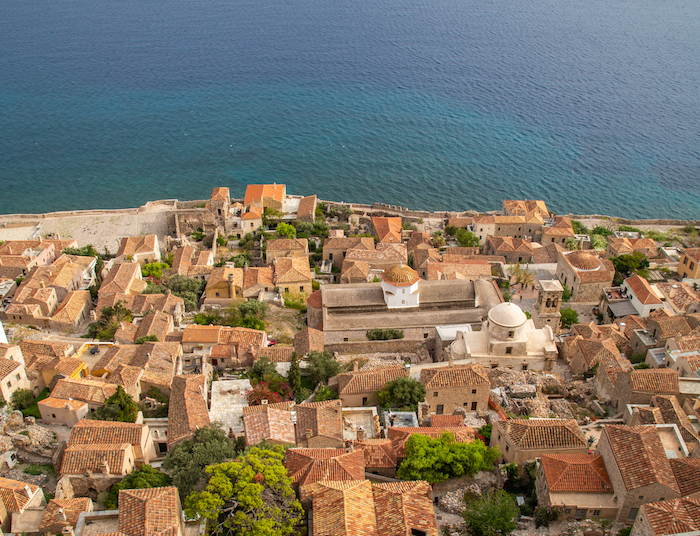
On Holy Saturday all roads lead to the main square of the lower town, where the oldest of its churches, Elkomenos Christos is located. It was probably built sometime in the 6th or 7th century and has undergone numerous transformations. Its sparse exterior does not prepare visitors for what is on display. Inside, a massive icon of the Crucifixion dates from the Palaeologan Renaissance (a short but culturally vibrant period during which the Palaeologos dynasty sought to restore the Byzantine Empire’s glory).
Once “Christos Anesti” (Christ Has Risen!) is heard for the first time, traditional Greek food is served across all the tables. This includes the mageiritsa soup and local delicacies such as pies with a very thin crust filled with greens called “saites” and “stamna” (pieces of pork with potatoes served in a clay pot).
On Easter Sunday, back to the town’s main square overlooking the sea where the historical landmark of “Kanoni” (canon) is located, the “burning of Judas” takes place. A human effigy made of wood and straw, filled with firecrackers is set ablaze as a panorama of sparklers begins.
Other things to do in Monemvasia during Greek Easter
During Easter’s reverent time, it is worth visiting the 12th-century church of Agia Sophia, the half-Byzantine, half-Venetian church clinging to the side of the cliff and is one of the most significant attractions in Monemvasia. Once inside, you’ll be awe-struck by its magnificent octagonal dome. It is believed that it is a replica of Hagia Sophia.
In the lower part of the town, one can explore the ruins of the historic buildings situated there—among which is the Muslim Mosque, a preserved 16th-century building housing the Archaeological Museum, and some magnificent Byzantine churches. Twenty-four temples and churches with Byzantine elements remain from the forty that once existed.
The castle town has seen a resurgence in importance, with more tourists visiting the site and the region of Laconia. Monemvasia consists of a labyrinth of winding cobblestone streets that can only be traveled by foot. The medieval buildings have been restored, and many have been converted into hotels, artisan shops, boutiques, cafés, and restaurants.
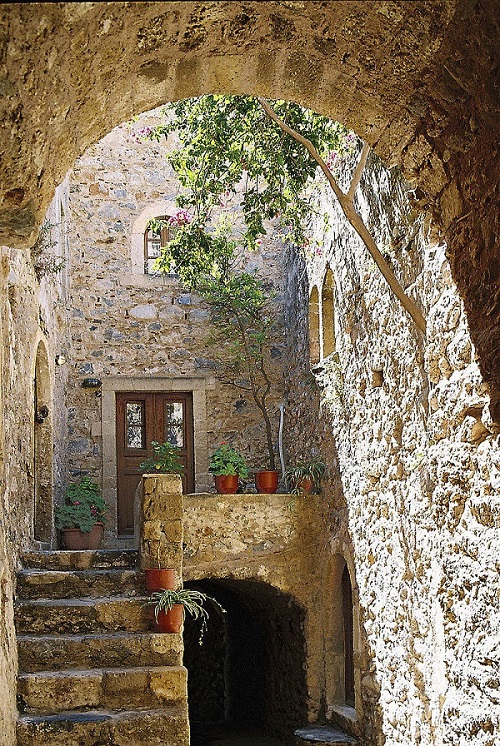
It has become an ideal romantic hideaway. Boutique bed and breakfasts and luxury hotels with suites boasting Turkish baths, mosaic floors, and flowering courtyards transport visitors to another time without stinting on modern comforts. Visitors will live their fairy tales in dimly lit rooms with vaulted ceilings and handmade wooden furniture.
Even a simple stroll amid the castle town’s cobblestoned lanes, lined with tall, slim, earthy-stone houses with arched doorways while smelling the sea salt from the nearby crashing waves as they blend with the aroma of the freshly bloomed flowers, is enough to remember British writer Brian W. Aldiss’ words, who once described Monevmasia as a “wonderful place,” where “only eagles and artists” should be allowed.
Business Wire



No comments