


Mount Pangaion: The Mountain of Gold and Ancient Greek Oracles

Mount Pangaion, a prominent peak in the ancient region of Thrace (modern Greek Macedonia), was a geographical nexus of wealth, mystery, and profound religious significance in the ancient world. Far from being a mere mountain, it was a mythological landscape deeply connected to the tumultuous world of the Thracian gods and heroes, most notably Dionysus and Orpheus.
Mount Pangaion: The seat of the Thracian oracle
The mountain’s primary claim to fame in the ancient world was as the home of the Oracle of Dionysus, a site of divination that rivaled the great pan-Hellenic sanctuaries.
The historian Herodotus (c. 484–425 BC), the earliest and most crucial source, explicitly places this oracle on the mountain and connects it to the indigenous Thracian tribes:
“The Satrae [Thracian tribe] have an oracle of Dionysus on their highest mountains… The priests who deliver the oracles are the Bessi…”
—Herodotus, Histories 7.111
Herodotus’s account establishes that the oracle was not a Greek import but a powerful indigenous Thracian cult adopted by the surrounding Greek cities. Prophecies were channeled by a priestess (a Promantis) and announced by priests, often in a state of religious ecstasy or intoxication, fitting for the god of wine and frenzy.
Its immense status is further evidenced by a later story involving the father of Emperor Augustus, who was said to have visited the sanctuary and received a prophecy foretelling his son’s world rule.
Dionysus and the madness of the mountain
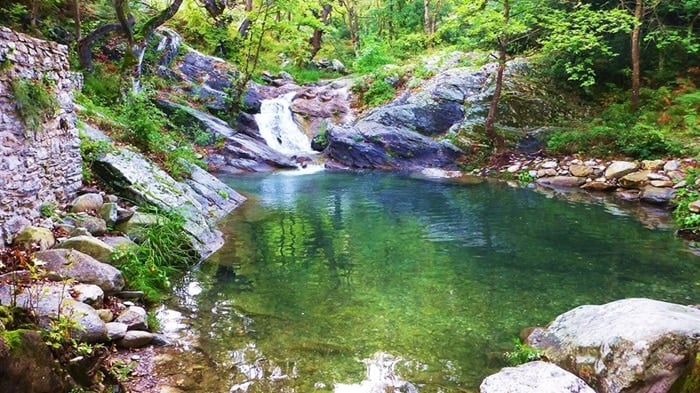
Mount Pangaion was considered one of the primary birthplaces and cult sites of Dionysus, the god of wine, ritual madness, and ecstasy. This connection is interwoven with the mountain’s topography and its native inhabitants:
The slopes and dense forests were legendary gathering places for the thiasos—Dionysus’s ecstatic retinue of Maenads and Satyrs—where they performed the frenzied rituals (orgia) central to his worship. Euripides alludes to these rites, referring to a “prophet of Bacchus” dwelling in a grotto beneath Pangaion.
The mountain is the setting for the tragic myth of Lycurgus, King of the Edones, who fiercely resisted the introduction of Dionysus’s worship. In punishment for his impiety, Dionysus drove him insane, leading him to tragically murder his own son, mistaking him for a vine. Lycurgus was eventually bound and died on Mount Pangaion. Apollodorus confirms this: “On hearing that, the Edonians led him to Mount Pangaion and bound him, and there by the will of Dionysus he died.”
Orpheus, the musician and martyr
Pangaion is perhaps even more tragically famous as the place of the death and dismemberment of Orpheus, the legendary musician, poet, and founder of Orphism.
Orpheus was believed to have been born in Thrace and had a deep connection to the Muses and Apollo. According to one tradition, his devotion to Apollo led him to reject Dionysus. In a furious retaliation, the Maenads (Bacchae), the female followers of Dionysus, attacked him on the mountain, tearing him to pieces in an act of Dionysian frenzy. Aeschylus’s lost play, Bassarids, dramatized this event, and later ancient authors, like Hyginus (Astronomica 2.7.1), place the event on Pangaion.
The Muses gathered his scattered body parts and buried them at the foot of the mountain, but his head and lyre floated down the Hebrus River to Lesbos, continuing to sing and give oracles, thus cementing the mountain’s reputation as a wellspring of both tragic music and prophecy.
Pangaion: The mountain of gold
Beyond its spiritual importance, Pangaion’s mythology was intrinsically linked to its geology. The mountain was renowned throughout the ancient world for its rich gold and silver mines.
Xenophon (c. 430–354 BC) referred to “the gold mines of Mount Pangaion” (Hellenika 5.2.17), while Thucydides noted Athenian interest in the region’s mineral wealth (Peloponnesian War 2.99).
This wealth—first exploited by the Thracians and later conquered by Philip II of Macedon to fund his armies—was seen by the ancients as a physical manifestation of the mountain’s sacred, mythical power. The gold and silver were often associated with the very coins struck in the region bearing the likeness of Dionysus.
Pangaion thus served as a powerful symbol: a source of both material wealth and spiritual ecstasy, a place where prophecy was delivered, and where the tension between the serene music of Orpheus and the wild frenzy of Dionysus played out on a monumental, legendary stage.
Business Wire



No comments