


How Greece’s Corinth Canal Took 2,500 Years to Complete
We all complain when roadwork drags on for a few extra months, but imagine waiting two and a half millennia for a project like Greece’s Corinth Canal to be completed.
Around 600 BC, Periander, the Ancient Greek ruler of Corinth, conceived a bold idea: to cut through the land so sailors would no longer have to risk their lives navigating the treacherous waters around the Peloponnese.
At first glance, the plan seems obvious, but the challenge lay in the local geography, which was essentially solid rock. In the end, it took the rise and fall of empires, the ambitions of several Roman emperors, and the invention of dynamite to finally link the Gulf of Corinth with the Saronic Gulf.
The ancients before the Corinth Canal existed
For the Ancient Greeks, the sea was central to life, but it was also extremely dangerous. The capes at the southern tip of the Peloponnese were notorious for wrecking ships. Periander understood that a shortcut through the narrow Isthmus of Corinth would transform trade and make his city extraordinarily wealthy. The challenge, however, was how to cut through miles of solid limestone using early iron and bronze tools. Quite simply, it could not be done.
Instead, they reached a compromise. The Corinthians constructed the Diolkos, a paved track that allowed ships to be hauled overland on wheeled carts. It was an enormous physical undertaking, yet in practice it proved highly effective. Greek and Roman merchants relied on this ingenious overland system for centuries. Even today, modern Greeks regard the Diolkos as a remarkable feat of maritime problem-solving, although the enduring vision of a true canal never fully disappeared.
The Romans and a golden pickax
By the Roman era, the canal project had gained the support of some of the most powerful figures in the empire. Julius Caesar and Caligula were both drawn to the idea, largely because a canal would allow their imperial fleets to move more efficiently across the Mediterranean. Notably, however, it was Nero who actually attempted to turn the vision into reality.
In the first century AD, Nero ceremoniously broke ground using, of all things, a golden pickax, accompanied by a musical ensemble. What followed was far less grand. He compelled thousands of Jewish prisoners of war to excavate a vast trench that, remarkably, aligns closely with the canal’s modern route. Political upheaval soon intervened. After Nero’s death, funding disappeared, and the project was abandoned. For centuries, the enormous half-finished trench remained a visible scar on the landscape, a reminder that nature often prevails over Roman—human—ambition.
It was not until the late 1800s that technology finally caught up with the long-standing vision. Inspired by the success of the Suez Canal, a newly independent Greece sought to demonstrate its ability to complete a world-class engineering project. This time, with dynamite and steam-powered machinery at their disposal, engineers were finally able to cut through the stubborn rock that had resisted every previous attempt for millennia.
The realization of a dream
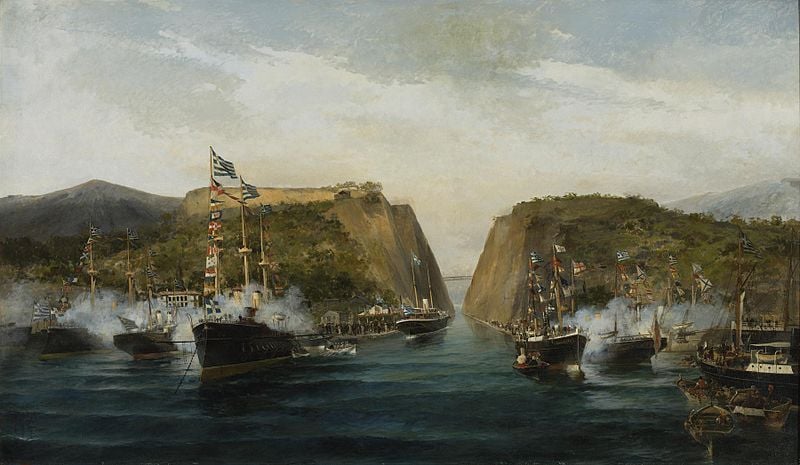
Even with dynamite and steam power, completing the Corinth Canal proved to be a Herculean task. The idea was revived soon after Greece gained independence in 1830, but an astronomical estimate of forty million gold francs (approximately two billion US dollars in today’s terms) quickly forced the project to be shelved. When construction finally began in April 1882 under the French-based international venture Société Internationale du Canal Maritime de Corinthe, history repeated itself, and funding ran out after eight years. Ultimately, a Greek company had to intervene to prevent the massive undertaking from collapsing once again. The canal was officially inaugurated on July 25, 1893 by Prime Minister Sotirios Sotiropoulos, fulfilling the vision of his predecessor, Charilaos Trikoupis.
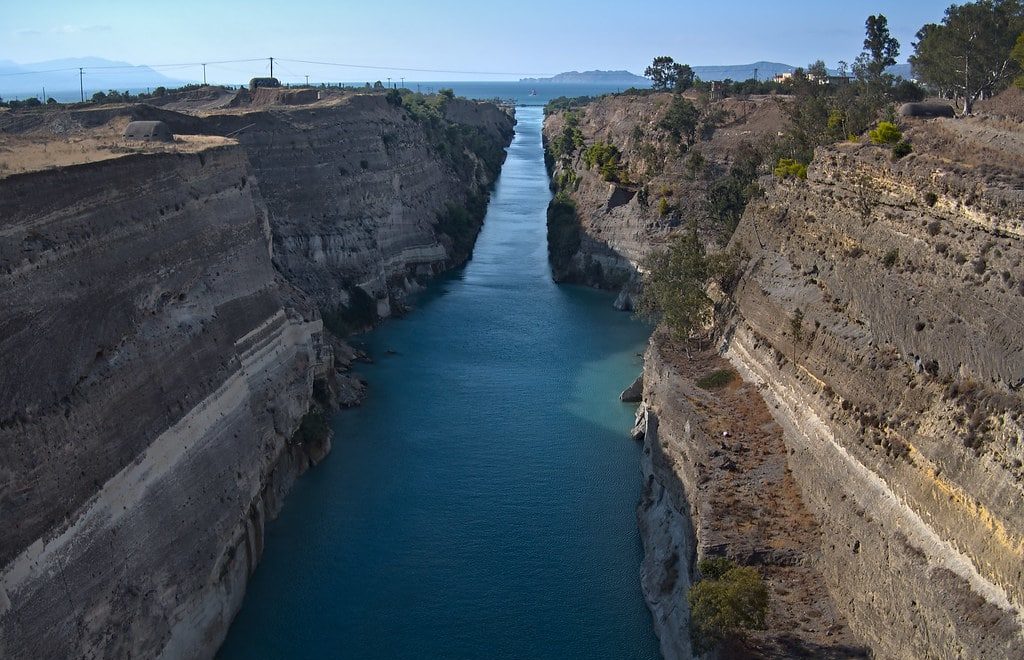
The finished canal was a monumental 6.3-kilometer (3.9-mile) passage carved through the earth, effectively severing the ancient land bridge and technically transforming the Peloponnese peninsula into an island. To maintain the connection between the mainland and the peninsula, a network of infrastructure now spans the gap, including road bridges, railway lines, and distinctive submersible bridges at both ends that sink into the water to allow ships to pass overhead.
Today, visitors are struck by the sheer vertical walls plunging into the vivid blue water below. Even so, the canal has not functioned without challenges. In reality, it is too narrow for modern container ships, and the steep limestone walls are prone to landslides. As a result, the passage must be closed and cleared frequently, making it a costly and ongoing maintenance challenge.
Business Wire




No comments